A Smarter Guide to Keeping Horses on Small Acreage
There is a picture many of us have in our heads when we think about finally bringing our horses home.
A beautiful barn. Rolling green pastures. Twenty, forty, maybe even a hundred acres. Horses grazing as far as the eye can see.
It sounds incredible.
But after spending roughly 20 years around horses, studying Equine Science, working as a luxury show barn manager, owning horses myself, and now specializing in equestrian real estate as a Certified Equestrian Property Specialist, I’ve learned something:
More acreage does not automatically mean a better horse property.
Sometimes, the best horse property is actually the smaller one that was designed exceptionally well.
For the hobby horse owner, busy professional, competitive rider, family with a couple of horses, empty nester, or longtime horse person who simply doesn’t want their entire life consumed by farm maintenance, a thoughtfully designed small acreage property can offer something incredibly valuable:
Simplicity.
And, when managed correctly, it can offer horses an excellent quality of life too.
First, Let’s Get Rid of the “Acres Per Horse” Myth
One of the most common questions people ask me about horse properties is:
“How many acres do I need per horse?”
The answer is more complicated than a single number.
There is a major difference between asking:
“How much land do I need to OWN a horse?”
and:
“How much pasture do I need to FEED a horse primarily through grazing?”
Those are not the same question.
University of Minnesota Extension, for example, generally recommends around two acres per 1,000-pound horse when the pasture is expected to provide most of the horse’s nutrition during the growing season.
But they also explain that a well-managed, productive pasture used primarily for exercise and supplemental grazing may require closer to one acre per horse, while poorer or less productive land can require considerably more.
Stocking capacity depends on soil, climate, forage productivity, drainage, management practices and what you’re actually asking the land to provide.
That’s incredibly important.
Because on many small horse properties, pasture doesn’t have to be the grocery store.
It can primarily be the playground.
Your horses’ nutritional needs can be met through purchased hay and appropriate supplemental forage while your acreage provides movement, turnout, grazing enrichment and space to simply be horses.
That isn’t some workaround invented by people who don’t own enough land.
Small-acreage horse management is specifically addressed by university Extension programs because it is a legitimate form of horse keeping.
A Horse Property Doesn’t Have to Be a Hay Farm
This is another misconception I hear frequently.
If you’re going to own horses, shouldn’t you have enough land to grow their hay?
Not necessarily.
I personally have no desire to become a hay farmer.
I love owning horses.
That doesn’t mean I also want to own, operate and maintain the equipment necessary to produce all of their forage.
Hay production requires land, equipment, labor, favorable growing conditions, storage and knowledge of forage production. Even then, Mother Nature gets a vote.
For many hobby horse owners, purchasing quality hay makes significantly more sense.
That allows your property to specialize in what YOU actually need it to do.
You can devote your usable acreage to turnout, paddocks, sacrifice areas, trails, an arena, barn space and other amenities rather than trying to make every available acre produce forage.
And there is absolutely nothing wrong with that.
My Own Decision to Downsize
I don’t just talk about smaller horse properties professionally.
I intentionally chose one myself.
I’ve owned property with more acreage before, and today I have a little over five acres with three horses.
That wasn’t something I “settled” for.
I downsized intentionally.
I wanted something I could maintain well.
I wanted beautiful fencing. Clean paddocks. Good pasture management. A nice barn. An arena. Easy chores. A property that looked attractive when I pulled into my driveway.
Most importantly, I wanted time to actually enjoy my horses.
Because there’s a point where owning more property doesn’t necessarily make your life easier.
Sometimes it just gives you more property to maintain.
More fencing.
More mowing.
More weeds.
More equipment.
More pasture.
More places to haul manure.
More things that break.
More money.
More time.
It’s the farm equivalent of buying a massive house and discovering that you spend all weekend cleaning rooms you barely use.
I wanted to focus on quality over quantity.
And one of the biggest things I’ve learned is that the number of acres on a listing sheet doesn’t tell me nearly as much as how those acres are laid out.
Five Acres Isn’t Always Five Acres
This is something I wish more horse-property buyers understood.
Two five-acre properties can function COMPLETELY differently.
Imagine one property where the house sits directly in the middle.
There is a large front yard.
A long driveway cuts through the property.
The septic system occupies another section.
There are mature trees scattered everywhere.
The remaining land is chopped into awkward little pieces.
Technically?
Five acres.
Functionally for horses?
Maybe not much at all.
Now imagine another five-acre property.
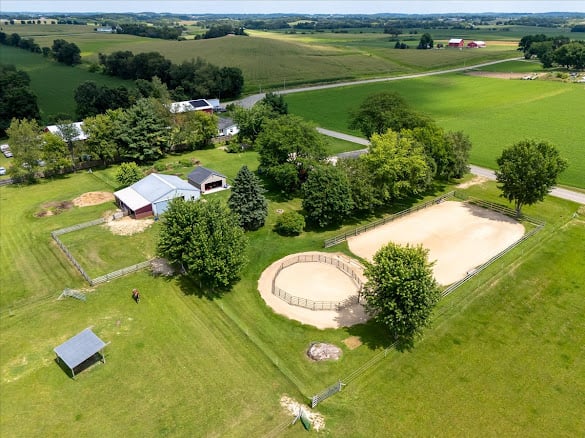
The house, garage, driveway and residential yard are concentrated on one side of the parcel.
The barn sits directly behind the residential area.
Water and electricity are conveniently accessible.
The remaining three or four acres are largely contiguous and usable for horses.
Suddenly that same five-acre number becomes incredibly functional.
That’s essentially what I looked for when choosing my own property.
My residential needs are concentrated on roughly one portion of my property, which allows me to dedicate most of the remaining usable land to horses and farm activities.
THAT is why property layout matters so much.
Sometimes I would rather show a horse buyer a brilliantly designed five-acre property than a poorly designed ten-acre one.
Infrastructure Can Be More Valuable Than Acreage
When I’m evaluating a smaller horse property, I’m looking beyond acreage.
I’m asking:
Where is the barn in relation to the house?
Where is the water?
Where is the electricity?
How far am I carrying buckets?
Where will hay deliveries go?
Can a truck and trailer maneuver here?
Where does manure go?
Where does water drain after a storm?
Can pastures be divided easily?
Where would a sacrifice area go?
Can horses move conveniently between their stalls, paddocks and turnout?
Could an arena fit here?
How much of this land is actually usable?
Where are the wetlands, slopes, woods, septic areas or other limitations?
Where will I be walking when it’s ten degrees outside?
That last question matters more than people realize.
When you’re doing chores twice a day, 365 days a year, efficiency becomes quality of life.
Not only for your horses.
For YOU.
A barn conveniently located near electricity and water can save an enormous amount of daily labor compared with having horse facilities scattered across a large property.
Think about every bucket, hay bale, feed bag, wheelbarrow and manure fork you’ll move over the next ten years.
Saving yourself a few hundred feet during every chore adds up.
Small Farms Can Be Fantastic for Busy Horse People
This lifestyle can be particularly appealing if you’re someone who:
• Owns a small number of horses.
• Works full time.
• Has children or a family.
• Competes or travels with horses.
• Doesn’t want to produce hay.
• Wants horses at home without operating a full-scale farm.
• Wants manageable property taxes and operating expenses.
• Doesn’t want to spend every weekend mowing.
• Is buying their first horse property.
• Is downsizing after years of owning a larger farm.
• Wants to invest more money into facilities rather than raw acreage.
• Wants an attractive, well-maintained property.
• Values convenience and efficient chores.
• Would rather own fewer horses exceptionally well than continually expand.
For these owners, a smaller farmette can be a sweet spot.
The Catch: Smaller Acreage Requires Smarter Management
Here’s the part I never want people to misunderstand.
Smaller acreage isn’t an excuse for overcrowding.
It actually requires you to be MORE intentional about management.
The biggest enemy of small horse properties is usually overgrazing.
Horses are extremely efficient grazers. They can graze vegetation very close to the ground, and they tend to repeatedly return to their favorite areas.
Without intervention, pasture quality can deteriorate.
Grass disappears.
Bare soil appears.
Then mud develops.
Weeds move in.
Soil becomes compacted.
And suddenly your beautiful little horse farm looks like a dirt lot.
The solution isn’t necessarily buying another twenty acres.
The solution is managing the acreage you have.
Rotational Grazing Is Your Friend
Instead of giving horses unrestricted access to every blade of grass you own all season, consider dividing pasture.
Portable or permanent interior fencing can allow you to create multiple grazing sections.
While horses use one section, others rest and regrow.
Oregon State University Extension recommends moving horses once forage has been grazed down to approximately three to four inches and waiting until it has recovered to roughly six to eight inches before grazing it again.
But pasture management shouldn’t simply follow a calendar.
Growth changes dramatically throughout the season.
Spring grass might recover rapidly.
During hot, dry summer conditions, recovery may slow dramatically.
Watch the GRASS, not just the date.
Your Dry Lot or Sacrifice Area Might Be One of Your Most Valuable “Pastures”
This sounds counterintuitive, but one of the best ways to maintain beautiful pasture on limited acreage is having somewhere horses can go when they SHOULDN’T be on pasture.
This is commonly called a dry lot, sacrifice lot, paddock or animal concentration area.
Think of it as intentionally sacrificing one smaller area so you don’t accidentally sacrifice the entire farm.
When your pasture is:
Too wet.
Too short.
Newly seeded.
Dormant.
Overgrazed.
Recovering.
Or simply needs a break.
Your horses have another appropriate outdoor area to use.
Oregon State University describes dry lots as one of the most important tools for protecting pasture on small-acreage farms.
And I LOVE them for smaller horse properties.
Design them correctly with appropriate footing, drainage, safe fencing, shelter and access to forage and water, and suddenly you’re no longer dependent on pasture being available every single day of the year.
Mud Management Matters
On smaller properties, high-traffic areas deserve extra attention.
Think:
Gates.
Water troughs.
Barn entrances.
Feed areas.
Shelters.
Dry lots.
Anywhere horses congregate.
These areas can become mud pits incredibly quickly.
Strategically installing appropriate heavy-use footing, improving drainage, redirecting roof runoff with gutters, and keeping manure picked can make a tremendous difference.
Sometimes spending money improving 2,000 square feet of heavily used ground does more for your everyday farm experience than purchasing another several acres of unmanaged land.
Manure Management Becomes Especially Important
A 1,000-pound horse can produce around 55 pounds of manure and urine combined per day.
University of Minnesota Extension estimates that adds up to more than 10 tons per horse per year.
Three horses?
You can quickly understand why manure management needs to be part of your property plan.
On smaller acreage, you can’t just continually move the manure pile farther away and forget about it.
Have a system.
Pick paddocks regularly.
Determine where manure will be stored.
Consider composting.
Determine whether it will be hauled away or appropriately applied.
Keep storage away from wells and waterways and follow applicable local regulations.
A clean small property can actually be incredibly pleasant to maintain when everything has a designated place.
Protect the Grass You Have
Your pasture is an asset.
Treat it like one.
Soil testing can tell you what your land actually needs rather than guessing with fertilizers.
Control weeds before they take over.
Mow when appropriate.
Reseed bare areas.
Don’t graze saturated ground.
Rest struggling pasture.
Move horses before they scalp grass down to nothing.
Use sacrifice areas when conditions aren’t appropriate for grazing.
And recognize that some years you’ll get more grazing than others.
Your goal doesn’t necessarily have to be producing enough calories to feed your horses year-round.
Sometimes your goal is simply maintaining healthy vegetation that provides supplemental forage, turnout and erosion control.
That is still an incredibly useful pasture.
Design for Movement
One concern people understandably have about smaller properties is whether horses have enough room to move.
This is where DESIGN becomes important again.
A four-acre property doesn’t mean a horse lives in a four-acre square.
You can create long paddocks.
Multiple connected areas.
Track systems.
Pasture lanes.
Runs attached to stalls.
Strategically separated water, shelter and feeding areas that encourage movement.
You can design the property so horses actually USE the land.
A larger property doesn’t automatically guarantee movement either.
I’ve personally boarded horses at facilities sitting on significantly more acreage where my horse’s actual daily turnout was dramatically smaller than what my horses have access to at home today.
The deed might say forty acres.
The horse doesn’t read the deed.
The horse experiences the environment we actually give them.
Smaller Can Also Mean Cleaner
This has probably been one of my favorite things about downsizing.
I can SEE my property.
I know what’s happening.
I notice broken fence.
I notice mud developing.
I notice weeds.
I notice manure accumulation.
I notice when a pasture needs a break.
I notice when something isn’t draining properly.
Everything feels accessible.
And because I’m not spreading my time and resources across huge amounts of land, I can invest those resources into maintaining what I DO have exceptionally well.
Better fencing.
Better footing.
Better barn improvements.
Better drainage.
Better pasture maintenance.
Better hay.
Better facilities.
That is quality over quantity.
Smaller Acreage Can Help Control Costs — If You Buy the RIGHT Property
Less acreage doesn’t automatically mean inexpensive horse ownership.
Let’s be clear: horses will always find creative ways to spend our money.
But a compact, efficient property can potentially reduce several ongoing expenses.
There may be less fencing to install and repair.
Less mowing.
Less fuel.
Less equipment.
Less snow removal around farm areas.
Less pasture renovation.
Potentially lower purchase costs compared with similarly improved properties on much larger acreage.
And infrastructure can be concentrated.
Rather than running water hundreds or thousands of feet, your barn, paddocks and water sources may be relatively close together.
Electricity can be easier to access.
Hay storage can be close to feeding areas.
Manure management can be centralized.
Your trailer can be parked close to your barn.
Your entire chore routine becomes tighter.
And time is a cost too.
If a thoughtfully designed property saves you thirty minutes of chores every day, that’s more than 180 HOURS every year.
That’s time you can spend riding.
Showing.
Taking your kids somewhere.
Working.
Relaxing.
Or standing in the pasture doing absolutely nothing except enjoying the horses you worked so hard to bring home.
Don’t Buy Acres. Buy FUNCTION.
This is probably the biggest piece of advice I can give prospective horse-property buyers.
Stop automatically sorting properties by the biggest acreage number you can afford.
Start asking:
What do I actually want my horse property to DO?
If you have two horses and no intention of ever owning twelve, why are you automatically assuming you need twenty acres?
Maybe you do.
But maybe you don’t.
Would you rather have:
Ten additional acres you don’t particularly need?
Or a smaller property with a beautiful barn, safe fencing, established paddocks, water, electricity, excellent drainage, trailer access and space for an arena?
There isn’t one correct answer.
There is only the answer that fits YOUR lifestyle.
This Is Where Working With Someone Who Understands Horses Matters
This is also exactly why I specialize in equestrian real estate.
I don’t look at a listing and simply see:
“5 acres.”
I see where horses could actually live.
I see pasture possibilities.
I see potential paddock configurations.
I see whether trailer access makes sense.
I see where an arena could potentially go.
I see whether your barn location will make chores convenient or miserable.
I see whether the residential footprint leaves enough contiguous usable land for your horses.
I look at how your everyday life could actually FUNCTION there.
A good equestrian property agent shouldn’t just help you find acreage.
They should help you find the RIGHT acreage.
Sometimes that’s forty acres.
Sometimes it’s ten.
And sometimes your dream property might be sitting on four or five incredibly well-designed acres.
Quality Over Quantity
I think we’re entering an era where more horse owners are realizing they don’t necessarily want the biggest farm they can possibly afford.
They want the farm they can actually enjoy.
People are busy.
Property is expensive.
Equipment is expensive.
Labor is expensive.
Time is valuable.
And plenty of horse people don’t dream about becoming full-time farmers.
They dream about looking out their kitchen window and seeing their horses.
They want to walk outside in their pajamas and feed breakfast.
They want to know exactly how their horses are being cared for.
They want to stop paying board.
They want their kids to grow up with horses in the backyard.
They want control over turnout, feeding and daily management.
They want their horses HOME.
You don’t necessarily need a sprawling estate to have that.
You need enough appropriate land for the number of horses you’re keeping, a management system capable of supporting them, safe facilities, reliable forage and water, and a property layout that actually works.
That’s a much more useful conversation than arguing over an arbitrary number of acres.
We All Start Somewhere
This might be the most important part of this entire conversation.
Horse people need to stop making other horse people feel like their dream isn’t good enough.
Maybe someone’s dream is forty acres, an indoor arena, twenty stalls and fields of homegrown hay.
That’s amazing.
Maybe someone else’s dream is four acres, two horses, a three-stall barn, a little arena and a dry lot behind their house.
That’s amazing too.
For many people, that little farmette represents YEARS of saving, working, planning and dreaming.
We all start somewhere.
And sometimes that “starter” farm ends up being exactly what we needed all along.
Your horses don’t care whether your property impresses somebody on Facebook.
They care that they have forage.
Fresh water.
Movement.
Friends.
Shelter.
Safe fencing.
Clean living conditions.
Good care.
And an owner who pays attention.
That’s why I’ll choose quality over quantity every single time.
A smaller horse property isn’t necessarily a compromise.
For the right horse owner, thoughtfully designed and responsibly managed, it might actually be the dream.
Whether you’re buying your first home, selling a property, or searching for the perfect farm, we're here to guide you every step of the way with honesty, exceptional service, and a seamless, stress-free experience.